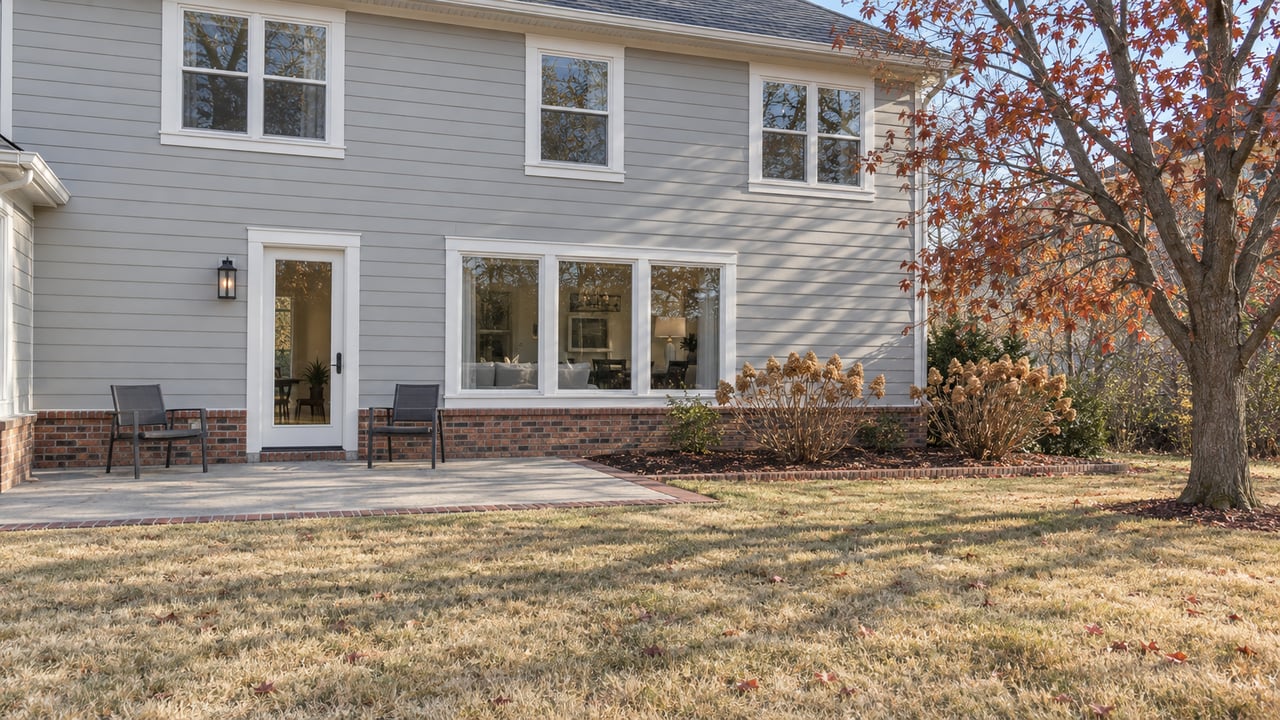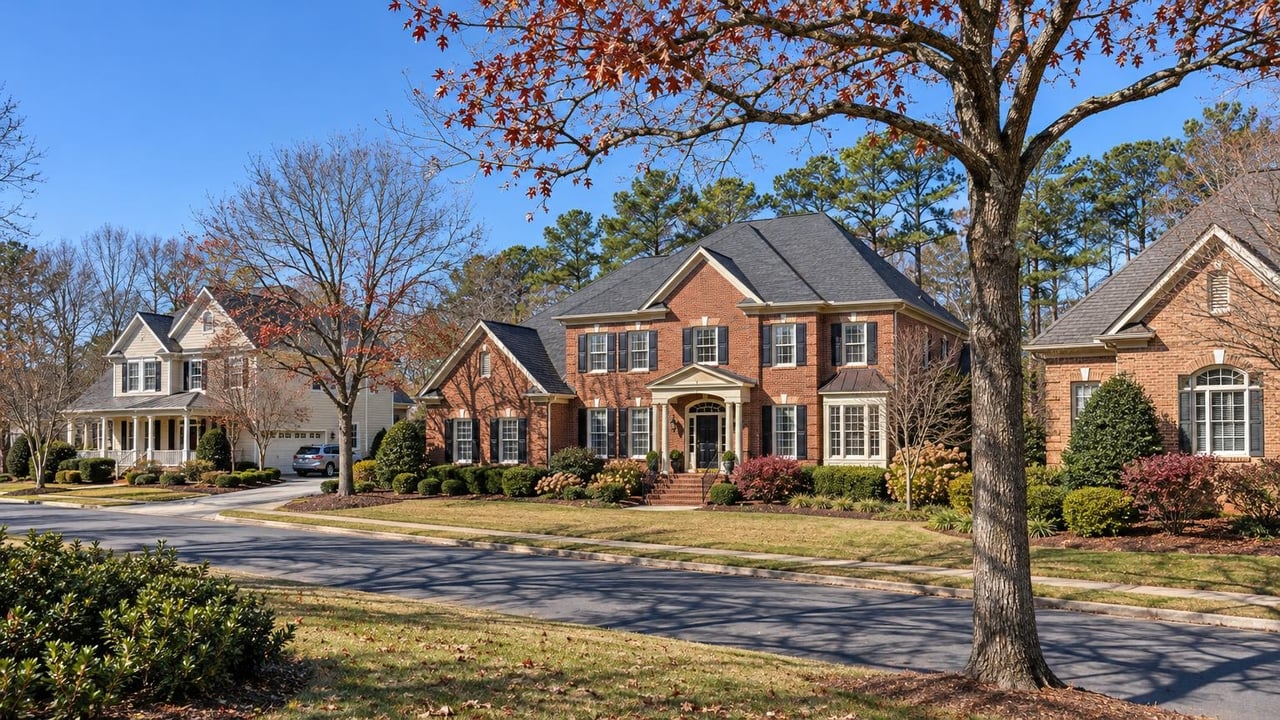
In October 2015, crews were building a house on Massy Branch Drive in Heritage Enclave, in the Rolesville part of Heritage. The News & Observer reported that month that only 52 of Heritage's 2,530 lots were left. The half-dozen custom builders holding those lots expected to sell them by the middle of 2016. That house is now about 11 years old. A house finished in Heritage's first year, 2001, would be 25.
Most people comparing homes for sale in Heritage start with the price and the street. We'd add the year the house was built and the company that built it, because Heritage went up in waves. Each wave left a different kind of house, and those houses now sit at different points in their maintenance cycle.
Fifteen years, and a dozen or more builders working at once
Heritage opened in 2001 and averaged 165 new-home sales a year through 2015. Ammons Development Group, the developer, says most new construction was done by 2016. The plan grew along the way. Early plans called for about 900 homes on roughly 1,008 acres, and the community eventually covered about 1,600 acres.
Who built those homes matters more here than in most Triangle subdivisions. The News & Observer reported that apart from a handful of houses from national builders, Heritage relied almost entirely on custom builders, with 12 to 22 of them active at any one time. By 2013 the community had 37 individual neighborhoods. That fall it put 17 homes from 11 builders into the Wake County Parade of Homes, the most of any community that year. The builders named in Heritage's 2013 Parade announcement were Homes By Dickerson, Foxwood Builders, Creech Construction Co, JordanBuilt Homes, Braswell Custom Homes, Medallion Construction, First Centrum, MBM Builders, Capitol City Homes, CityScape Builders and L and L of Raleigh.
Some of those builders are tied to particular sections. The 2013 Parade results put Medallion in Heritage Gates and L and L of Raleigh in Heritage Cornerstone and Heritage Gates. Foxwood and MBM were in Heritage Valley, Homes by Dickerson and CityScape in Heritage Woodlands, and Creech in Heritage Walk. JordanBuilt's entry was in Traditions at Heritage. Medallion alone sold about 125 Heritage homes in the seven years before 2015, according to the News & Observer. A 2014 News & Observer story described C.R. Spainhour Custom Homes as five years into building in Heritage, with four lots underway in Heritage Enclave.
For a buyer, this means two houses on the same street can come from different companies, built to different specs in different years. Some of those builders still answer the phone. MBM Builders says it has worked in the Triangle since 2005 and still lists Heritage among its communities, and Homes By Dickerson is still building custom homes in the region. When you know the builder, you can ask the right questions about the plan, the materials and the original specs.
The 2006 wave turns 20 this year
The biggest single year was 2006, when Heritage sold 270 new homes. Those houses are about 20 years old this month, and the homes sold in the years just before and after are 18 to 22. That's the age when the original parts of a house start to come due.
The best-known estimates come from a February 2007 National Association of Home Builders and Bank of America study, along with InterNACHI's life-expectancy chart. Both describe their numbers as estimates that depend on installation, maintenance, climate and use.
| Component | NAHB/Bank of America estimate, 2007 study | InterNACHI range | Original part in a 2006 Heritage home, November 2026 |
|---|---|---|---|
| Asphalt shingle roof | About 20 years | 20 years for 3-tab, 30 for architectural | About 20 years old |
| Heat pump | 16 years | 10 to 15 years | About 20 years old |
| Central air conditioner | 10 to 15 years | 7 to 15 years | About 20 years old |
| Tank water heater | About 10 years, 10 to 11 in the table | 6 to 12 years | Likely replaced at least once |
| Wood deck | 10 to 15 years in the South | 10 to 30 years for structural wood | About 20 years old |
Windows vary more by material. NAHB puts aluminum windows at 15 to 20 years and wood windows at upwards of 30. InterNACHI lists vinyl and fiberglass at 20 to 40.
Here's what that means when you compare two listings. A 2006 house whose seller replaced the roof and heat pump in the last few years has already paid that bill. A 2006 house with its original roof and systems still has it ahead. If both are listed at the same price, they aren't the same deal.
The downturn houses are smaller on purpose
The next wave looks different for a reason. When the market turned in 2009, Heritage let its builders recalculate lot prices based on current conditions while the developer kept a fixed percentage of each sale. The News & Observer reported that this let builders put up smaller, more affordable homes during the downturn and let lot prices climb again once the market recovered. Heritage's director of residential operations, Clark Alcock, told the paper, "So our builders could still build the prices that people wanted in the market, but when prices went back up we could get lot prices back where they needed to be."
Sales held up through that stretch and reached 252 new homes in 2012. So Heritage has a sizable group of homes from roughly 2009 to 2012 that were scaled to a downturn budget, sitting in the same community as larger homes from the years before and after. Through those years, the community's best-selling homes were four-bedroom houses priced between $375,000 and $450,000.
For a buyer, these homes are in the middle of their maintenance cycle. At 14 to 17 years old, a heat pump is around the NAHB's 16-year estimate, while the roof is a few years short of its 20. The floor plans may also be tighter than a 2006 home's at a similar price. That's one reason a single Heritage median price hides so much, as we covered in our breakdown of the Heritage median price.
The last sections are still young
The final wave went east. In 2013, many of Heritage's Parade homes were in a new phase of four neighborhoods in the Rolesville section. In 2015, the last section under construction was in that eastern area, Heritage Enclave.
A few smaller enclaves were built on their own schedules. Heritage Spring is a group of 48 townhomes built from 2007 to 2015 by Centennial Builders. It's a sub-association of Heritage Wake Forest Two, also known as Heritage South, according to its HOA information sheet. Because it was built over eight years, two Heritage Spring townhomes can be nearly a decade apart in age. The Courtyards at Heritage Grove came later. Epcon Communities started construction there in 2014, with homes dating from 2016 to 2021, which makes it one of the youngest pockets in Heritage.
In these later sections, original roofs and systems are mostly still within their estimated lifespans. The tradeoff often shows up elsewhere, in location within the community, lot size or the sub-association layer. We cover that last part in the Heritage cost stack and our look at Heritage's two HOAs.
What this winter's market adds
Build year matters more when buyers have time to compare, and the latest numbers point that way. NC REALTORS reported 5.98 months of inventory statewide for October 2026, up 7.3% from a year earlier. Sales fell 19% over the same period, and the statewide median sales price was $368,990, down 0.4%. Those are statewide figures, not Heritage numbers. Closer to home, Wake County's Register of Deeds reported a $475,000 median transfer price for October 2026, up from $450,000 in September. That median comes from deed transfers that carried excise-tax consideration, not from MLS home sales.
With more listings on the market and fewer sales across the state, a buyer looking at a Heritage home with a 20-year-old roof has more room to factor that age into the offer. Sellers should know that buyers can see the build year too. A seller with receipts for a new heat pump or roof has a clear point to make in the listing. Our home valuation tool is a starting point, and the replacement records fill in the rest.
If you're comparing Heritage homes from different years and builders this winter, Carolina Elite Realty Group can help you sort them by what was built when, who built it and what has been replaced since, before you write an offer. Schedule Your Consultation, and bring the addresses you're considering.